
Hosted PBX vs Traditional PBX: Which Call Management System Is Right for Your Business?
Managing business calls efficiently is no longer just a nice-to-have — it’s a competitive necessity. Whether you’re running a small startup or scaling a mid-sized enterprise, the phone system you choose can directly impact customer satisfaction, team productivity, and your bottom line. That’s why the debate between hosted PBX vs traditional PBX has become one of the most important decisions IT managers and business owners face in 2026.
In this guide, we’ll break down both systems, compare their strengths and weaknesses, and help you determine which solution best fits your organization’s needs.
What Is a PBX System and Why Does It Matter for Call Management?
Before diving into the comparison, let’s establish a clear foundation.
A Private Branch Exchange (PBX) is a telephone system used within a business that allows internal communication between employees and manages inbound and outbound calls. Think of it as the central hub of your entire business communication infrastructure.
PBX systems handle essential call management functions such as:
- Call routing and forwarding
- Voicemail and auto-attendants
- Conference calling
- Call queues and hold music
- Extensions and direct dial numbers
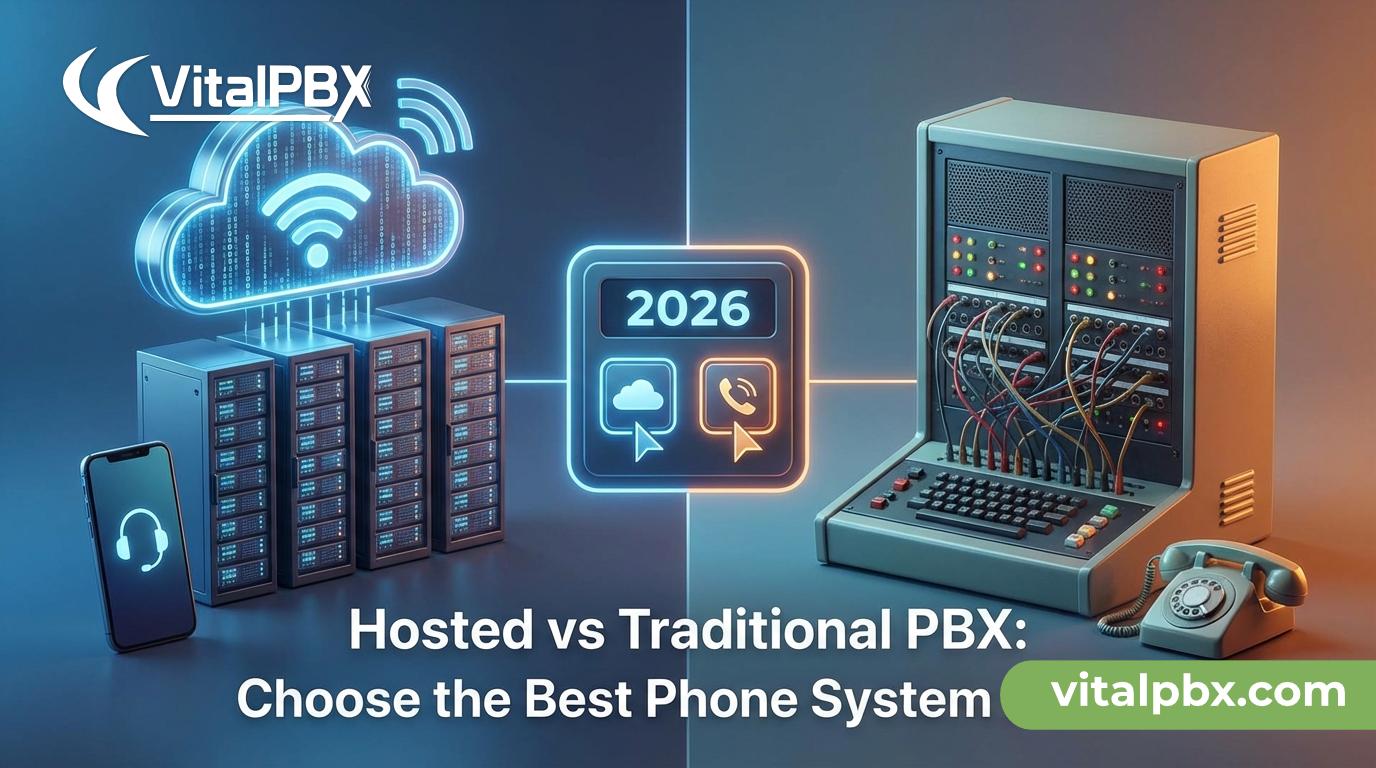
The two dominant types of PBX systems are traditional (on-premise) PBX and hosted PBX (cloud-based). Understanding the difference between them is critical to making the right investment.
Understanding Traditional PBX: The On-Premise Approach
Traditional PBX systems have been the backbone of business telephony for decades. These systems rely on physical hardware installed at your office, including servers, circuit boards, and handsets connected through a wired network or legacy telephone lines (PSTN).
How Traditional PBX Systems Work
With a traditional PBX, all the equipment is located on-site at your business premises. Your IT team (or an external vendor) is responsible for:
- Installing and maintaining the hardware
- Managing software updates and patches
- Troubleshooting technical issues
- Expanding the system when the business grows
Popular legacy PBX providers include Avaya, Cisco, and NEC. These systems were dominant for decades because they offered reliability, control, and voice quality before the internet made cloud solutions viable.
Advantages of Traditional PBX
- Full control over hardware and data — everything stays on your premises
- Consistent voice quality independent of internet connectivity
- No monthly recurring fees after the initial investment
- Works without an internet connection, making it resilient in connectivity outages
Disadvantages of Traditional PBX
- High upfront costs — hardware, installation, and licensing can run into tens of thousands of dollars
- Difficult to scale — adding lines or extensions requires physical hardware changes
- Maintenance burden — your team or a vendor must handle all repairs and updates
- Limited remote work support — traditional systems are not built for distributed teams
- Technology is aging — PSTN networks are being phased out globally, with many carriers ending support by 2027
According to Gartner, organizations that continue relying on legacy telephony infrastructure risk significant service disruption as PSTN switch-offs accelerate worldwide.
What Is Hosted PBX? The Cloud-Based Alternative
A hosted PBX (also called cloud PBX or virtual PBX) moves the entire phone system to the cloud. Instead of owning and managing physical hardware, your business subscribes to a service provider who hosts all the PBX infrastructure remotely. Calls are routed over the internet using Voice over IP (VoIP) technology.
How Hosted PBX Systems Work
With a hosted PBX solution, your phones (IP phones, softphones, or mobile apps) connect to the internet and communicate with a cloud-based server managed by your provider. The provider handles:
- System maintenance and upgrades
- Security and redundancy
- Scalability on demand
- Feature deployment
VitalPBX, for example, is a powerful open-source PBX platform that can be deployed on your own server or in the cloud, giving businesses the best of both worlds — full control and modern cloud capabilities.
Advantages of Hosted PBX
- Low upfront investment — no expensive hardware to purchase
- Easy scalability — add or remove users in minutes
- Remote and hybrid work ready — employees can connect from anywhere in the world
- Automatic updates — your provider handles all software upgrades
- Rich features included — IVR, call recording, analytics, CRM integrations, and more
- Predictable monthly costs — easier for budgeting and financial planning
Disadvantages of Hosted PBX
- Dependent on internet connectivity — a poor connection can affect call quality
- Ongoing subscription fees — costs accumulate over time
- Less direct control — you rely on the provider for uptime and security
- Data privacy considerations — sensitive call data lives in a third-party environment
However, many of these concerns can be mitigated by choosing a self-hosted or hybrid solution like VitalPBX, which gives you cloud flexibility without sacrificing data ownership.
Hosted PBX vs Traditional PBX: A Head-to-Head Comparison
Let’s look at the key differences between these two systems across the most important decision-making factors.
| Feature | Traditional PBX | Hosted PBX |
|---|---|---|
| Upfront Cost | High ($10,000–$100,000+) | Low to moderate |
| Monthly Cost | Low (after initial setup) | Predictable subscription fee |
| Scalability | Difficult and costly | Instant and flexible |
| Maintenance | In-house or vendor | Provider-managed |
| Remote Work Support | Limited | Excellent |
| Call Quality | Consistent | Dependent on internet |
| Setup Time | Weeks to months | Hours to days |
| Disaster Recovery | Complex | Built-in redundancy |
| Advanced Features | Limited (add-on costs) | Included by default |
| Future-Proof | At risk (PSTN phase-out) | Yes (IP-based) |
Which Businesses Should Choose Hosted PBX?
In 2026, the shift toward cloud communications has accelerated dramatically. The global cloud PBX market is projected to exceed $20 billion by 2027, according to MarketsandMarkets. This growth is driven by the rise of remote work, digital transformation, and the increasing obsolescence of traditional telephony infrastructure.
Hosted PBX Is the Right Choice If You:
- Have a remote or hybrid workforce spread across multiple locations
- Want to minimize capital expenditure and shift to operational spending
- Need to scale your phone system up or down quickly
- Require advanced call management features like CRM integration, call analytics, and AI-powered routing
- Are a small to medium-sized business without a dedicated IT team
- Want to future-proof your communication infrastructure
Traditional PBX May Still Make Sense If You:
- Have already made a significant hardware investment and want to maximize ROI before migrating
- Operate in a location with unreliable internet connectivity
- Have strict data sovereignty or compliance requirements that prevent cloud use
- Run a very large enterprise with deep customization needs already built into legacy systems
That said, even large enterprises are migrating to hybrid or fully hosted models to stay competitive.
The VitalPBX Advantage: Open-Source PBX Power for Modern Businesses
Not all hosted PBX solutions are created equal. Many cloud PBX providers lock you into proprietary systems, charge per-feature fees, and limit your customization options. VitalPBX takes a different approach.
Why VitalPBX Stands Out in the Hosted PBX Market
VitalPBX is a comprehensive, open-source PBX platform built on Asterisk — one of the most trusted telephony engines in the world. It can be deployed on your own hardware, a private cloud, or a public cloud server, giving you total flexibility.
Key highlights of VitalPBX include:
- Intuitive web-based GUI — manage your entire phone system without command-line expertise
- Advanced call center features — queues, IVR, call recording, wallboards, and real-time statistics
- Unlimited extensions — no per-user licensing fees that drain your budget
- Built-in security features — fail2ban integration, encryption, and access controls
- Rich add-on ecosystem — CRM connectors, WebRTC, high availability modules, and more
- Active community and commercial support — get help when you need it
With VitalPBX, businesses get the best of both worlds: the control and customization of an on-premise system with the modern features and flexibility of a hosted PBX solution.
You can explore how VitalPBX compares to other platforms in our article on the best open-source PBX solutions for businesses and learn about advanced call routing strategies on the VitalPBX blog.
Frequently Asked Questions: Hosted PBX vs Traditional PBX
What is the main difference between hosted PBX and traditional PBX?
The main difference is where the system is hosted. Traditional PBX relies on physical hardware installed at your office, while hosted PBX runs on cloud servers managed by a provider. Hosted PBX is accessed over the internet, making it more flexible and scalable.
Is hosted PBX more expensive than traditional PBX?
It depends on your time horizon. Traditional PBX has a high upfront cost but lower ongoing fees. Hosted PBX has lower startup costs but involves monthly subscription fees. For most small and medium businesses, hosted PBX proves more cost-effective over a 3–5 year period when you factor in maintenance, upgrades, and hardware replacement.
Can I use a hosted PBX system for remote workers?
Absolutely. Hosted PBX is purpose-built for distributed teams. Employees can connect via IP phones, desktop softphones, or mobile apps from anywhere in the world — making it ideal for remote and hybrid work environments.
What happens if my internet goes down with a hosted PBX?
Most hosted PBX providers offer failover options such as call forwarding to mobile numbers or backup SIP trunks. With VitalPBX, you can configure high-availability setups and failover rules to ensure business continuity even during connectivity disruptions.
Is VoIP the same as hosted PBX?
Not exactly. VoIP (Voice over Internet Protocol) is the technology that transmits voice calls over the internet. Hosted PBX is a complete phone system that uses VoIP as its underlying technology. Think of VoIP as the engine and hosted PBX as the full vehicle.
Is traditional PBX being phased out?
Yes, gradually. PSTN networks — the backbone of traditional PBX — are being decommissioned in many countries. The UK, for example, plans to complete its PSTN switch-off by 2027. Businesses still relying on traditional PBX systems should plan their migration to cloud or IP-based systems now.
Did You Know?
- Over 70% of businesses are expected to operate on cloud-based communication platforms by the end of 2026.
- Companies that switch to hosted PBX report an average cost reduction of 20–40% on communication expenses.
- Remote teams using cloud PBX systems show higher call resolution rates due to better call routing and availability features.
- VitalPBX supports WebRTC, allowing browser-based calls without any additional software — perfect for remote teams.
Conclusion: Making the Right Call for Your Business
The comparison between hosted PBX vs traditional PBX ultimately comes down to your business priorities. If you value flexibility, scalability, lower upfront investment, and the ability to support a modern remote workforce, hosted PBX is the clear winner in 2026 and beyond.
Traditional PBX systems served businesses well for decades, but the rapid evolution of cloud technology, the phase-out of legacy telephone infrastructure, and the demands of today’s distributed workforce make the case for migration increasingly compelling.
The good news? You don’t have to choose between power and simplicity. VitalPBX delivers a feature-rich, open-source PBX solution that gives your business enterprise-grade call management without the enterprise price tag.
Ready to modernize your business communication system? Download VitalPBX for free today and discover why thousands of businesses around the world trust it as their go-to call management platform. Visit vitalpbx.com to get started — no credit card required, no vendor lock-in, just powerful, flexible telephony on your terms.