

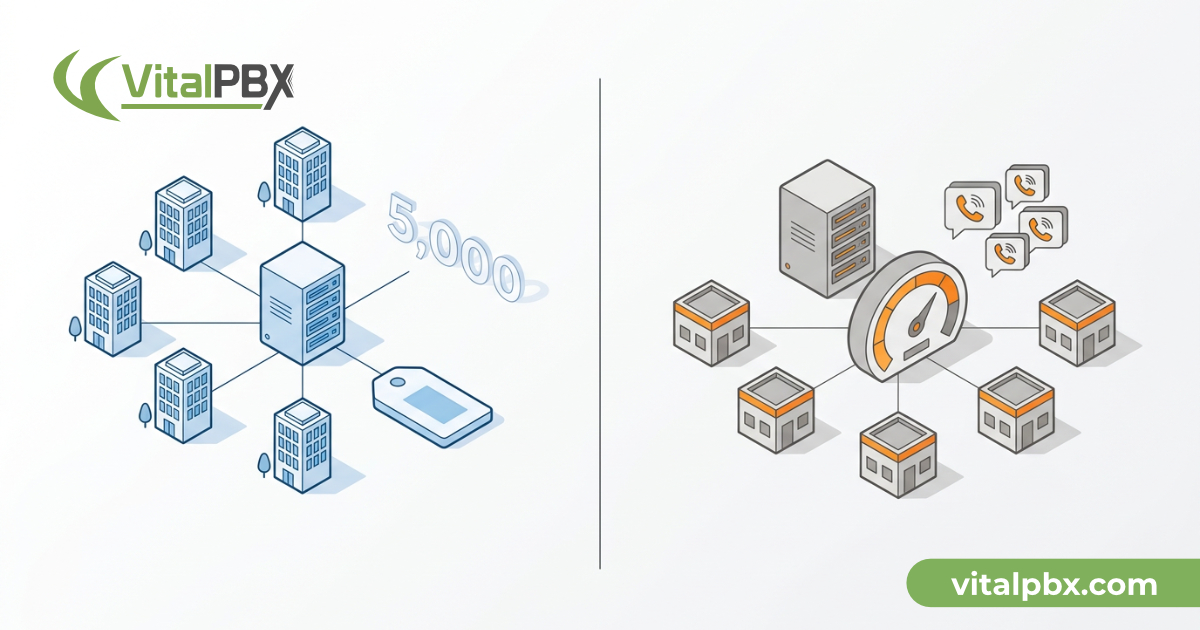
If you’re an MSP, ITSP, or reseller deciding between VitalPBX and 3CX for hosting multiple customers on shared infrastructure, the “multi-tenant” label on both vendors’ sites hides some real differences in licensing, tenant limits, and what each tenant actually gets. This article compares VitalPBX Multi-Tenant and 3CX Multi-Tenant side by side, using only publicly documented facts from both vendors, so you can see which architecture fits your customer base before you commit a license.
How Multi-Tenant Works on Each Platform
Multi-tenant PBX means one server hosts multiple isolated, independent companies, instead of standing up a dedicated server per client. Both VitalPBX and 3CX offer this — but as the next section shows, they don’t isolate those tenants the same way, and that difference matters more than the marketing label does.
VitalPBX offers multi-tenancy as a dedicated Multi-Tenant plan, self-hosted on a Debian 12 64-bit server (on-premise or any VPS/cloud provider — AWS, DigitalOcean, Vultr, etc.). It supports up to 5,000 extensions total on a license, with no per-user or per-extension fee — the cost is the same whether you’re running 10 extensions or 5,000 [VitalPBX Plans & Pricing]. Multi-tenant capability is also bundled into the lower-cost VitalPBX One plan.
3CX added a dedicated Multi-Tenant capability in late 2024, allowing partners to host multiple companies — each isolated as a separate “department” — on a single 3CX instance instead of a dedicated server per client [3CX Multi-Tenant PBX]. 3CX positions this specifically for smaller accounts: its own FAQ states multi-tenant is “ideal for smaller SOHO/SMB style businesses with up to 10 users and basic to moderate communications requirements” per tenant [3CX Multi-Tenant PBX].
True Multi-Tenant vs. Department-Based Isolation
This is the architectural difference behind the commercial one, and it’s worth understanding before you size a license.
VitalPBX’s Multi-Tenant plan follows the strict definition of multi-tenancy: each hosted company runs as its own fully isolated instance on the shared server, with its own independent numbering plan. Because tenants don’t share a numbering space, two different tenants can each use extension 101 with no conflict between them — there’s no crossover by default. If two tenants ever want to reach each other directly, that’s set up deliberately through a dedicated trunk between them, not something that happens automatically because they share hardware.
3CX’s multi-tenant capability isolates each customer as a department inside one shared 3CX instance, which still keeps each company’s calls and data separate day to day — but every department draws from the same shared numbering plan. 3CX’s own documentation confirms that extension numbers can’t be duplicated across tenants, so each customer needs its own dedicated extension range, and tenants can’t dial each other’s extensions directly — that also has to route through SIP trunks, the same as any outside call [3CX Multi-Tenant PBX].
In practice: VitalPBX’s isolation is architectural — each tenant behaves like an independent PBX that happens to share a server. 3CX’s is organizational — separate departments partitioned within one shared numbering plan.
Licensing & Capacity
This is where the two platforms diverge most.
VitalPBX Multi-Tenant is priced as a flat plan: $250/month, $2,500/year, or a $10,000 one-time license, covering up to 5,000 extensions with no per-user surcharge [VitalPBX Plans & Pricing]. VitalPBX doesn’t publish a fixed maximum number of tenants — but a practical ceiling of roughly 100 tenants per server applies due to a limitation in the underlying Asterisk engine, regardless of how many extensions your license allows.
3CX Multi-Tenant uses 3CX’s standard Simultaneous Call (SC) licensing, with one important detail: SC capacity is pooled across every tenant on the instance, not allocated per tenant. 3CX’s own documentation confirms there’s no way to cap how many simultaneous calls one tenant consumes — you size the whole subscription for total anticipated usage across all tenants combined, and upgrade the license key as that usage grows [3CX Multi-Tenant PBX]. The minimum license size to enable multi-tenant is 16SC Basic [3CX Multi-Tenant PBX]. A single license key covers every tenant on the instance, and the hosting partner — not the individual tenant companies — is the registered 3CX customer of record, taking on all responsibility for customer communication [3CX Multi-Tenant: Making Your SMB Customers Profitable Again].
3CX doesn’t publish a fixed cap on tenant count either — it depends on your extension numbering plan (a 3-digit plan holds fewer tenants than a 5-digit plan) and your server hardware [3CX Multi-Tenant PBX]. Third-party pricing guides report 3CX’s PRO edition starting around €395–795/year at the low end and scaling into the tens of thousands for high-capacity Enterprise/AI editions, though exact current rates should be confirmed on 3CX’s own pricing calculator since they change with regional promotions [3CX pricing overview via CloudTalk, current as of this article’s research date].
What Each Tenant Actually Gets
A few feature-scope details matter for anyone evaluating this at the tenant level, not just the license level:
- CRM integration: VitalPBX offers native CRM integrations with Zoho CRM, Odoo, and Salesforce. On 3CX, CRM integration is documented as a dedicated-instance-only feature — a separate CRM per customer is explicitly not available in 3CX’s multi-tenant mode [3CX Multi-Tenant PBX].
- Department structure: Each 3CX tenant is limited to a single department; if a client needs multiple departments, 3CX’s own guidance is to move that client to a dedicated instance instead [3CX Multi-Tenant PBX].
- Reporting: 3CX does provide per-tenant call reporting even in multi-tenant mode [3CX Multi-Tenant PBX]. VitalPBX’s Sonata Stats and Sonata Billing add-ons cover call center reporting and tenant billing/cost management for partners running its Multi-Tenant plan.
- Setup: Both platforms support manual tenant creation through the admin interface and programmatic creation via API — 3CX through its XAPI configuration REST API [3CX Multi-Tenant PBX].
Which Fits Your Business Better
If you’re an MSP or ITSP serving mostly small accounts — think SOHO clients under 10 users each — 3CX’s multi-tenant tier is built explicitly around that profile, and 3CX states it directly in its own FAQ. If your book of business includes larger tenants, or you want to avoid recalculating simultaneous-call capacity every time a client’s usage grows, VitalPBX’s flat, extension-based Multi-Tenant plan (up to 5,000 extensions, no per-user fee) removes that variable from your pricing math.
There’s also an onboarding advantage that has nothing to do with price: because VitalPBX gives every tenant its own independent numbering plan, you don’t have to coordinate one shared extension range across your entire client base before adding a new tenant. Each client keeps whatever numbering scheme makes sense for them — including overlapping extension numbers with another tenant — since there’s no shared numbering plan to conflict with in the first place. [Link: VitalPBX Plans & Pricing — vitalpbx.com/pbx-plans-and-pricing-vitalpbx-system/]
Frequently Asked Questions
What does “multi-tenant” mean in a PBX system?
Multi-tenant means one server hosts multiple customers or companies, each isolated from the others, instead of requiring a dedicated server per client. Both VitalPBX and 3CX offer this, though they isolate tenants differently: VitalPBX gives each tenant its own independent numbering plan with no crossover, while 3CX separates tenants as departments that share one numbering plan.
What’s the difference between VitalPBX’s multi-tenant architecture and 3CX’s department model?
VitalPBX isolates each tenant with its own independent numbering plan, so two tenants can use the same extension number without conflict, and tenants only reach each other if you deliberately set up a trunk between them. 3CX isolates tenants as departments within one shared 3CX instance, so every tenant draws from the same numbering plan — 3CX’s own documentation confirms extension numbers can’t be duplicated across tenants and each customer needs a separate extension range.
How is VitalPBX Multi-Tenant licensed?
VitalPBX’s Multi-Tenant plan is a flat license — $250/month, $2,500/year, or a $10,000 one-time purchase — covering up to 5,000 extensions with no per-user or per-extension fee. The same license cost applies whether you’re running 10 extensions or 5,000.
How is 3CX Multi-Tenant licensed?
3CX Multi-Tenant uses 3CX’s standard Simultaneous Call (SC) licensing, starting at a minimum of 16SC Basic. Simultaneous call capacity is shared across all tenants on the instance rather than allocated per tenant, so the license must be sized for total usage across every hosted company combined.
Can each tenant have its own CRM integration on 3CX?
No. 3CX’s own documentation states that a separate CRM integration per customer is not available in multi-tenant mode — CRM integration on 3CX requires a dedicated, single-tenant instance.
Is there a hard limit on how many tenants VitalPBX or 3CX can host per server?
Neither vendor publishes a single fixed number. VitalPBX has a practical ceiling of roughly 100 tenants per server due to the underlying Asterisk engine. 3CX’s tenant capacity depends on your extension numbering plan length and server hardware, with no published fixed maximum.
Which is better for an MSP serving a mix of small and larger clients?
It depends on client size. 3CX explicitly positions its multi-tenant tier for SOHO/SMB clients with up to 10 users each. VitalPBX’s Multi-Tenant plan supports up to 5,000 extensions total with no per-user fee, which can simplify pricing for MSPs managing a wider range of client sizes.
VitalPBX’s Multi-Tenant plan comes with a 30-day free trial (credit card required, no charge if cancelled before the trial ends), or you can book a demo to see it configured for your customer base.
Sources & Methodology
Researched and fact-checked on July 28, 2026, from the following official and third-party sources:
- VitalPBX Plans & Pricing — vitalpbx.com
- 3CX Multi-Tenant PBX — 3cx.com
- 3CX Multi-Tenant: Making Your SMB Customers Profitable Again — 3cx.com, Nov 18, 2024
- 3CX Pricing & Plans Guide 2026 — CloudTalk (third-party, secondary source for indicative pricing only)
Comparison based on publicly available information from 3CX and VitalPBX as of July 28, 2026. Features, pricing, and specifications are subject to change; readers should verify current details on each vendor’s official website. 3CX® is a registered trademark of 3CX Ltd. VitalPBX is a trademark of VitalPBX LLC. This content is independently produced and is not sponsored, endorsed by, or affiliated with 3CX Ltd.