


VitalPBX 4.5.4 R1 shipped on September 2, 2026, and it’s a meaningful update — not just a patch release. The core engine moves to Asterisk 20.21.0, call recordings and voicemails finally get real access controls, and the Realtime AI Agents module picks up a built-in email tool along with support for OpenAI’s newest GPT-Realtime models.
If you manage a VitalPBX system — or you’re comparing PBX platforms and want to see how actively this one is maintained — here’s everything that changed in 4.5.4 R1, and why it matters.
What’s New in VitalPBX 4.5.4 R1
- Updated: Asterisk core upgraded to version 20.21.0
- Added: Secure access protection for call recordings and voicemails, with embedded playback support for CRM platforms like Zoho, Salesforce, and Odoo
- Added: Realtime AI Agents now support OpenAI’s GPT-Realtime 2.1 and GPT-Realtime 2.1 Mini models
- Added: A built-in email tool for Realtime AI Agents, for sending call summaries, lead details, and other captured information automatically
- Added: SIP and SMS messages sent to offline devices are now queued and delivered once the device reconnects
- Compatibility: PJSIP now supports legacy TLS 1.0 and TLS 1.1, for older IP phones that can’t negotiate newer TLS versions
- Fixed: PJSIP trunk registrations no longer run into unintended contact limits by default
- Fixed: Missed call notifications are no longer sent to queue or ring group members when another agent already answered
- Fixed: Recording previews now play concatenated system audio files correctly
- Fixed: PBX Monitor no longer shows stale TCP contacts as active after they’ve disconnected
Let’s walk through the highlights.
Asterisk 20.21.0: A More Stable Core
Every VitalPBX release inherits the reliability of the Asterisk engine underneath it, and 20.21.0 is a solid upgrade on the stability front. Two changes stand out for anyone running production PBX traffic:
PJSIP TCP transport stability. A bug that could stop the PJSIP TCP transport from processing after certain upgrades has been resolved, which is exactly the kind of low-level fix that prevents mysterious call-routing stalls.
Call handling reliability. Asterisk 20.21.0 fixes an intermittent call drop that could happen when a re-INVITE changed the offered codec mid-call, and it closes a lock-inversion deadlock between the RTP instance and the underlying media engine — both real-world causes of dropped or hung calls under load.
On top of that, this release adds proxy support and keepalive options for outbound WebSocket connections (useful for ARI and external media integrations), and updates the bundled JSON library (jansson) for better stability. None of these are features you’ll click on in the GUI, but together they make the platform your extensions and trunks depend on more resilient.
Protect Call Recordings and Voicemails
This is the feature most VitalPBX admins have been asking for. Under Settings → HTTP Server → Recordings Security, you can now lock down access to call recordings and voicemails instead of relying on obscure URLs alone.
Turn on Protect Call Recordings & Voicemails and choose a protection method — a required secret token/key is the first option available. From there you control exactly who can reach a recording:
- Allowed Domains / Referers — restrict playback to specific domains, so a recording link only works when it’s embedded or opened from a trusted site (e.g.,
crm.zoho.com,*.zoho.com,*.force.comfor Salesforce) - Allowed IPs / Subnets — restrict access by network, useful for internal tools or site-to-site setups
That domain-allowlist option is what makes embedded playback in CRM platforms like Zoho CRM, Salesforce, and Odoo work cleanly: your sales or support team can play a call recording directly inside the CRM record they’re already working in, without exposing the file to anyone who happens to guess or intercept the link. For call centers and compliance-conscious teams, this closes a real gap.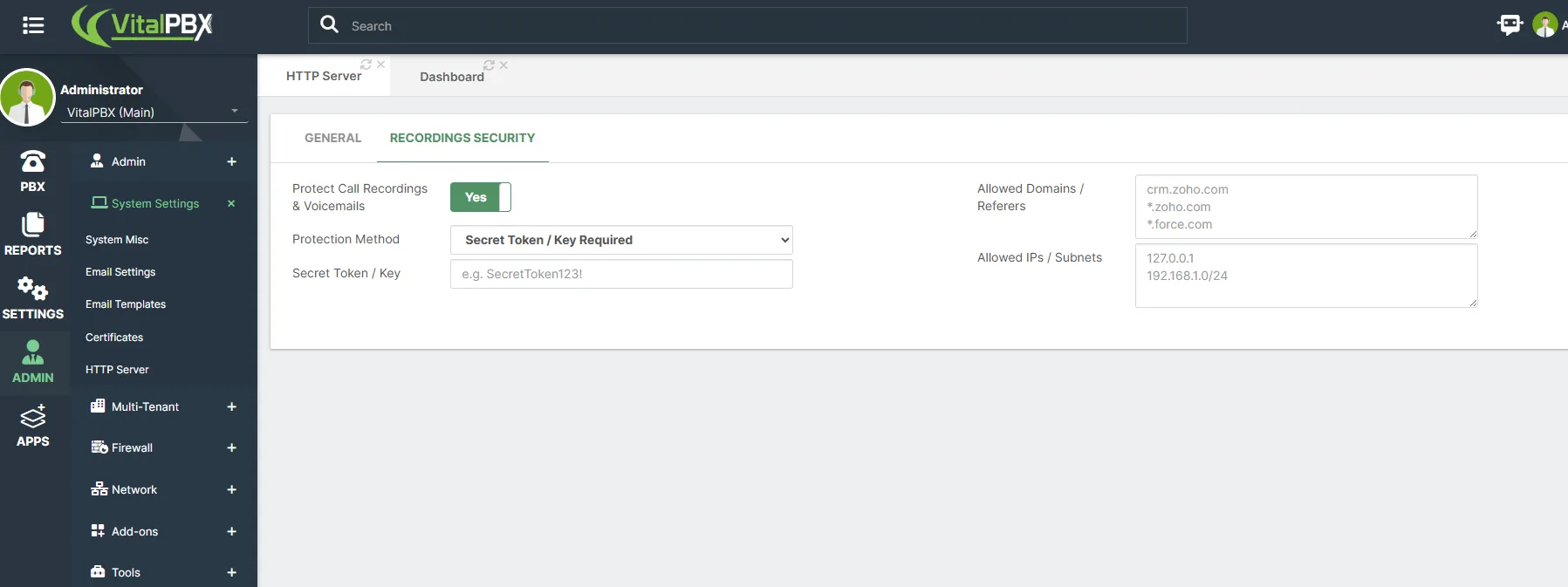
Realtime AI Agents Get Smarter
VitalPBX’s AI Voice Agents module — configured under Settings → AI Voice Agents → Realtime Agents — gets two upgrades in this release.
GPT-Realtime 2.1 and GPT-Realtime 2.1 Mini support. You can now select OpenAI’s newer Realtime models as the AI Model for your agents, alongside the transcription and analysis model options already available (GPT-4o mini Transcribe, GPT-5 Mini, and others).
A built-in email tool. There’s a new Notifications E-mail Addresses field on the agent’s General tab. Add one or more addresses there, and VitalPBX enables an internal send_email tool the agent can call on its own — based on its instructions — to send things like conversation summaries, customer orders, or questionnaire results as soon as a call wraps up. Previously, getting structured output out of a call meant building that logic yourself through an external integration; now it’s a native option baked into the agent configuration.
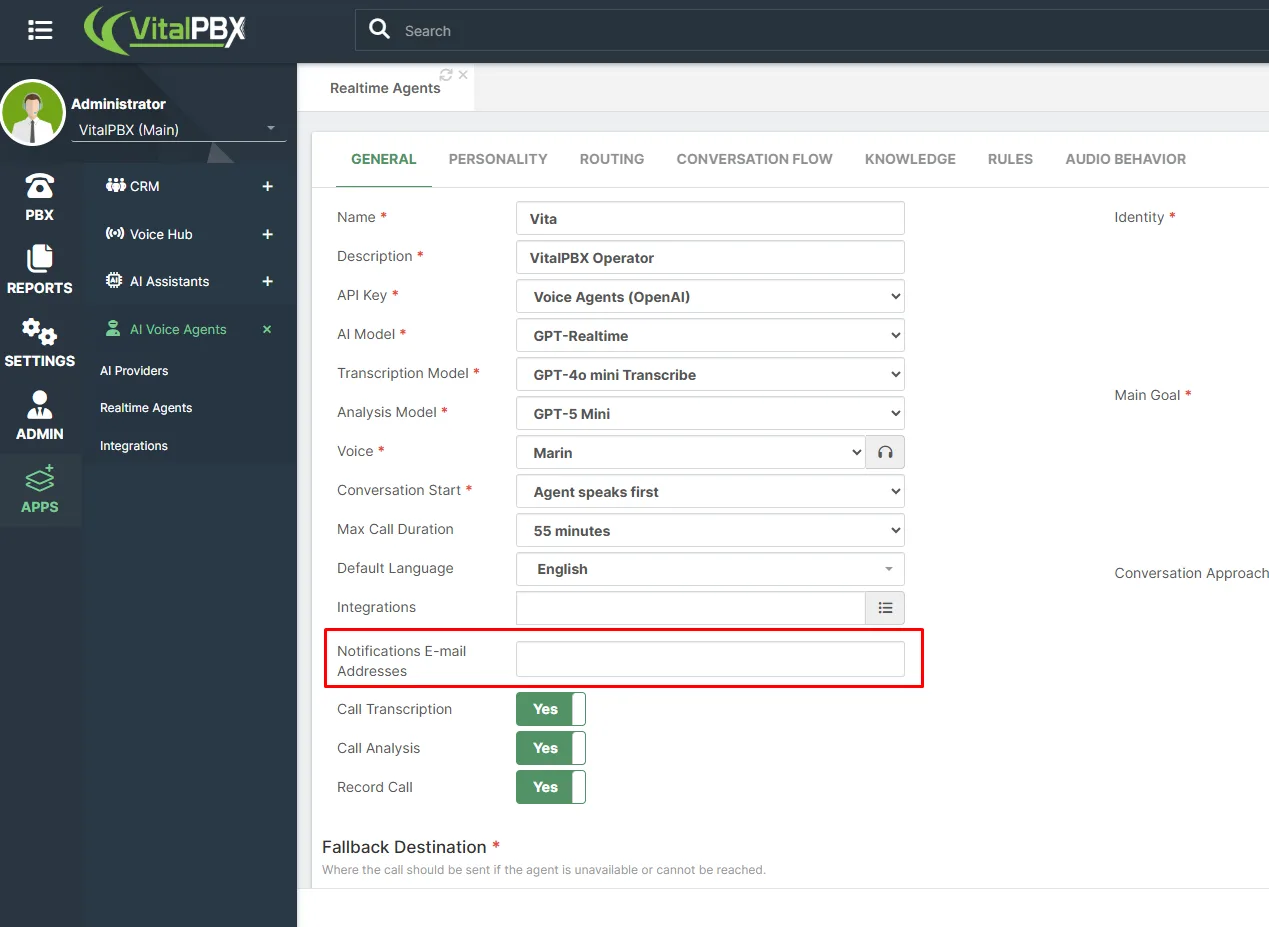
Combined with the existing Call Transcription, Call Analysis, and Record Call options, this makes it realistic to run an AI agent that answers a call, qualifies a lead, and emails the summary to your sales team — without a single external automation.
Other Improvements Worth Knowing About
A few smaller but genuinely useful changes rounded out this release:
- Offline message queueing. SIP and SMS messages sent to a device that’s offline are now held and delivered automatically once that device reconnects, instead of silently failing.
- Legacy TLS compatibility. PJSIP now supports TLS 1.0 and TLS 1.1, so older IP phones that can’t negotiate modern TLS can still register securely — a practical fix if you support a mixed fleet of desk phones.
- Trunk registration limits. PJSIP trunk registrations no longer hit unintended contact limits by default, which was causing avoidable registration failures for some providers.
- Notification accuracy. Missed call notifications no longer fire for queue or ring group members when a teammate already answered the call.
- Recording playback. Previews of concatenated system audio files now play back correctly.
- PBX Monitor accuracy. Disconnected TCP contacts no longer show as active in PBX Monitor, so your at-a-glance status view can be trusted.
How to Update to VitalPBX 4.5.4 R1
Updates ship through VitalPBX’s standard update process on Debian 12 64-bit minimal — there’s no separate download or reinstall required. Before updating any production system, back up your configuration first.
VitalPBX Update & Upgrade Documentation — wiki.vitalpbx.com
Frequently Asked Questions
What is VitalPBX 4.5.4 R1?
VitalPBX 4.5.4 R1 is a release of the VitalPBX PBX phone system published on September 2, 2026. It upgrades the underlying Asterisk engine to version 20.21.0 and adds new features including protected call recordings, an AI agent email tool, GPT-Realtime 2.1 support, offline message queueing, and several stability fixes.
What version of Asterisk does VitalPBX 4.5.4 R1 use?
VitalPBX 4.5.4 R1 runs on Asterisk 20.21.0. This upgrade focuses on PJSIP TCP transport stability, fixes for call drops during codec renegotiation, a lock-inversion deadlock fix in the RTP engine, and additional upstream reliability fixes.
How do I protect call recordings and voicemails in VitalPBX?
Go to Settings → HTTP Server → Recordings Security, turn on “Protect Call Recordings & Voicemails,” and choose a protection method such as a required secret token or key. You can also restrict access by allowed domains/referers or by allowed IPs/subnets, which is what enables secure embedded playback in CRM platforms like Zoho CRM, Salesforce, and Odoo.
Which AI models does the VitalPBX Realtime AI Agents module support?
As of 4.5.4 R1, VitalPBX Realtime AI Agents support OpenAI’s GPT-Realtime and GPT-Realtime 2.1 (including the Mini variant) as the conversation model, GPT-4o mini Transcribe for transcription, and GPT-5 Mini for call analysis.
What is the new email tool for AI Voice Agents?
It’s a built-in send_email tool that a Realtime AI Agent can trigger on its own, based on its instructions, to send call summaries, lead details, questionnaire results, or other information collected during a call. You enable it by adding one or more addresses to the “Notifications E-mail Addresses” field in the agent’s General settings.
Can I still connect older IP phones after this update?
Yes. VitalPBX 4.5.4 R1 adds PJSIP compatibility with legacy TLS 1.0 and TLS 1.1, so older IP phones that can’t negotiate newer TLS versions can continue to register securely.
How do I update to VitalPBX 4.5.4 R1?
Update through VitalPBX’s standard update mechanism on Debian 12 64-bit minimal. Back up your configuration before updating any production system, and consult the official documentation for step-by-step instructions.
VitalPBX 4.5.4 R1 is a good example of what “built on Asterisk, backed by active development” actually looks like release over release: a hardened core, tighter security around sensitive data like recordings, and AI features that keep pace with what OpenAI is shipping. If you’re already running VitalPBX, updating gets you all of this with no extra cost per extension. If you’re not, this is the kind of release cadence you’re signing up for.
VitalPBX Plans & Pricing — vitalpbx.com/pbx-plans-and-pricing-vitalpbx-system/