

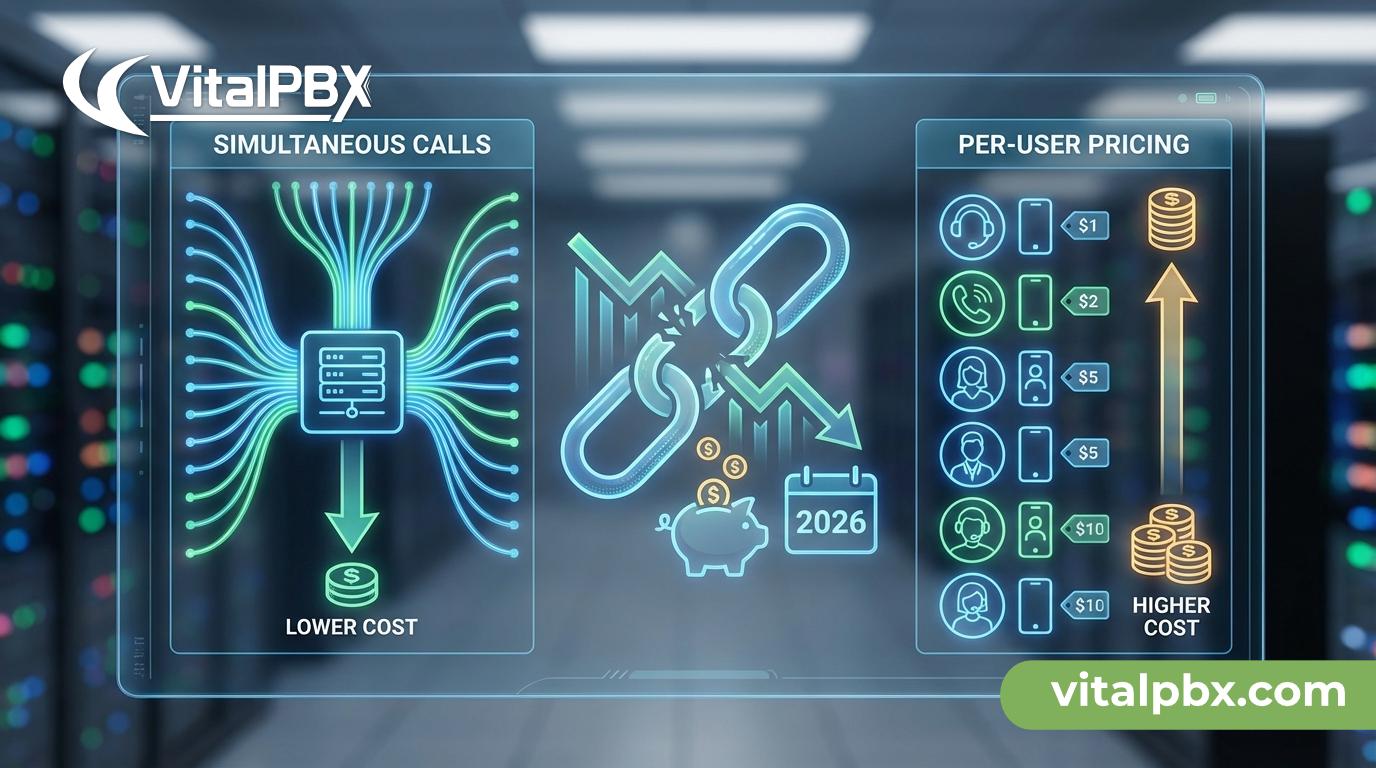
Simultaneous Calls vs. Per-User Pricing: A Simple Guide to Modern PBX Costs
If you’ve ever tried to compare business phone system pricing, you’ve probably run into two very different pricing models: simultaneous calls (also called concurrent calls) and per-user (or per-seat) pricing. Understanding the difference between these two models can save your business thousands of dollars per year — and help you choose the right PBX solution for the way your team actually communicates.
In this guide, we break down both pricing structures in plain English, compare their real-world costs, and show you how modern open-source PBX platforms like VitalPBX give you even more flexibility to take control of your communication budget.
What Is “Simultaneous Calls” Pricing?
Simultaneous calls pricing — sometimes called concurrent call pricing — charges you based on how many phone calls your business can have active at the exact same moment, regardless of how many total users or extensions you have.
Think of it like lanes on a highway. If you have 10 simultaneous call channels, then up to 10 conversations can happen at the same time. If an 11th person tries to make or receive a call, they’ll get a busy signal or be queued until a channel frees up.
How It Works in Practice
Let’s say your business has 50 employees, but at any given moment, only 15 of them are actually on a call. In a simultaneous calls model, you’d only pay for those 15 channels — not for all 50 users.
This model is common with:
- SIP trunking providers that charge per channel
- On-premises PBX systems like VitalPBX
- Self-hosted or cloud PBX deployments
The Key Advantage of Concurrent Call Pricing
The biggest benefit is cost efficiency for larger teams. If your workforce has many users but relatively low call concurrency (common in offices where employees communicate heavily through email or chat), you pay only for actual phone usage — not for potential usage.
What Is “Per-User” Pricing?
Per-user pricing (also called per-seat pricing) charges a flat monthly fee for every individual user registered on your phone system — whether they made a single call that month or hundreds.
This is the dominant model used by most hosted UCaaS (Unified Communications as a Service) providers, including platforms like RingCentral, Zoom Phone, Microsoft Teams Phone, and Vonage Business.
How It Works in Practice
If you have 50 employees and your provider charges $25 per user per month, you’re paying $1,250 per month — regardless of whether 10 of those employees rarely pick up the phone. Scale that to 200 users, and you’re looking at $5,000 per month just for the base license.
Per-user pricing is straightforward and predictable, which is why many businesses default to it. But “simple” doesn’t always mean “affordable.”
When Per-User Pricing Makes Sense
Per-user pricing can be a good fit when:
- You have a small team (under 20 users) with consistent call volumes
- Every employee is a heavy phone user
- You need bundled features (video, messaging, CRM integrations) and want one flat invoice
- Your IT team prefers minimal management overhead
Simultaneous Calls vs. Per-User: A Side-by-Side Cost Comparison
To make this concrete, let’s compare the two models using a realistic business scenario.
Scenario: A 100-person company where, on average, 20 employees are on the phone at any given time.
| Pricing Model | Unit Cost | Units Needed | Monthly Cost | Annual Cost |
|---|---|---|---|---|
| Per-User (Hosted UCaaS) | $25/user/month | 100 users | $2,500 | $30,000 |
| Simultaneous Calls (SIP Trunking) | $15/channel/month | 20 channels | $300 | $3,600 |
| VitalPBX (Self-Hosted + SIP Trunk) | $0 license + SIP costs | 10 channels | ~$300–$500* | ~$3,600–$6,000* |
*Estimated cost including server hosting and SIP trunking. Actual costs vary by provider and configuration.
The difference is dramatic. A company with 100 employees could potentially save over $24,000 per year by switching from a per-user hosted model to a concurrent call model with a self-hosted or open-source PBX.
Of course, these savings come with trade-offs — more on that below.
The Hidden Costs: What Each Model Doesn’t Tell You
Neither pricing model tells the full story on its own. Let’s look at what’s often left out of the conversation.
Hidden Costs in Per-User Pricing
- Tiered feature locks: Many providers offer three or four tiers (Basic, Standard, Premium, Enterprise). The features you actually need — call recording, IVR menus, advanced analytics — are often locked behind higher tiers, sometimes adding $10–$20 more per user per month.
- Add-on charges: International calling, toll-free numbers, call center queues, and CRM integrations often cost extra.
- Long-term contracts: Many hosted providers lock you into 1–3 year contracts, making it costly to switch providers mid-term.
- Vendor lock-in: Your configuration, call history, and extensions often can’t be easily migrated to another platform.
Hidden Costs in Simultaneous Call / Self-Hosted PBX Pricing
- Initial setup costs: Deploying an on-premises or cloud-hosted PBX requires IT expertise or a managed service partner.
- Hardware costs: Physical IP phones, servers, and network equipment need to be purchased and maintained.
- Internal management time: System updates, security patches, and user management require IT resources.
- SIP trunking fees: You still pay your SIP trunk provider for channels, inbound/outbound call minutes, and DID numbers.
The good news? Platforms like VitalPBX dramatically reduce the complexity and cost of self-hosted PBX deployments. With a free open-source core and an active community, businesses can deploy a full-featured phone system without the per-user price tag.
For a deeper look at how VitalPBX compares to hosted solutions, check out this article on VitalPBX vs. Hosted PBX: Which Is Right for Your Business?
How VitalPBX Changes the PBX Pricing Equation
VitalPBX is a free, open-source PBX platform built on Asterisk, designed to give businesses of all sizes enterprise-grade communication features without the enterprise price tag.
Here’s why it stands out in the simultaneous calls vs. per-user pricing debate:
No Per-User Licensing Fees
VitalPBX does not charge per user or per extension. You can add 10 users or 1,000 users — the core software cost remains the same. This makes it one of the most cost-effective platforms for growing businesses.
Unlimited Extensions, No Caps
Unlike most hosted platforms that charge for every additional seat, VitalPBX allows you to configure as many extensions as your infrastructure supports. A retail chain with 200 staff across 10 locations doesn’t pay per employee — they pay for the infrastructure that supports their call volume.
Full Control Over Your Concurrent Calls
With VitalPBX, your call capacity is determined by your SIP trunk provider and server resources — not by a software license limit. You scale your channels based on actual need, not on a per-user billing schedule.
Feature-Rich Without Hidden Charges
VitalPBX includes out of the box:
- IVR (Interactive Voice Response) menus
- Call queues and ring groups
- Call recording and CDR reporting
- Voicemail to email
- Multi-tenant support
- WebRTC softphone compatibility
- CRM integrations via add-ons
Many of these features cost extra on per-user hosted platforms. With VitalPBX, they’re included.
You can also explore how VitalPBX handles call center features and SIP trunk configuration in our other guides.
Which Pricing Model Is Right for Your Business in 2026?
With the rise of remote work, hybrid teams, and AI-powered communication tools, the question of PBX pricing is more relevant than ever. Here’s a quick framework to help you decide.
Choose Per-User Pricing If:
- You have fewer than 20 employees and minimal IT resources
- You need a plug-and-play solution with no setup required
- Every employee is actively using the phone system daily
- You want bundled video, chat, and voice in one app
Choose Simultaneous Calls / Self-Hosted PBX If:
- You have more than 30 employees with varied call volumes
- Your team includes many “light users” who rarely make calls
- You want full control over your data and infrastructure
- You’re running a call center, a multi-site business, or a managed service provider (MSP)
- You want to avoid long-term vendor contracts
According to Metrigy’s 2026 Workplace Communications & Collaboration research, a growing number of mid-market businesses are moving away from pure per-seat UCaaS toward hybrid and self-hosted models precisely because of cost and control concerns — a trend that benefits platforms like VitalPBX directly.
Frequently Asked Questions About PBX Pricing Models
Q: What is the difference between concurrent calls and simultaneous calls?
These terms are interchangeable. Both refer to the number of active phone calls happening at the exact same moment on your phone system. Your PBX and SIP trunk need enough capacity (channels) to support all calls happening simultaneously.
Q: Is per-user pricing always more expensive?
Not always. For very small teams where nearly everyone is a heavy phone user, per-user pricing can be comparable or even simpler to manage. However, for teams of 30 or more with mixed usage patterns, simultaneous call pricing is almost always more cost-effective.
Q: Can VitalPBX work with any SIP trunk provider?
Yes. VitalPBX is SIP-standard compliant and works with virtually all major SIP trunking providers worldwide, including Twilio, VoIP.ms, Telnyx, and many regional carriers.
Q: Does VitalPBX charge per extension or per user?
No. VitalPBX’s core software is free and open source with no per-user or per-extension licensing fees. Optional commercial add-ons and support plans are available for businesses that want enhanced features or professional support.
Q: How many simultaneous calls does VitalPBX support?
VitalPBX’s call capacity depends on your server hardware and SIP trunk channel allocation — not on any software-imposed limit. A properly configured server can handle hundreds of concurrent calls.
Q: What is a SIP trunk channel?
A SIP trunk channel is essentially a single “lane” for a phone call. If you have 10 SIP channels, 10 calls can be active at the same time. Adding more channels increases your concurrent call capacity.
Did You Know?
- The average office worker spends only about 10–15% of their workday on active phone calls — meaning per-user pricing charges you for 85–90% of idle phone capacity.
- Businesses that switch from hosted per-user UCaaS to a self-hosted PBX with concurrent call pricing report average savings of 40–70% on communication costs annually.
- VitalPBX is deployed in over 150 countries, making it one of the most widely used open-source PBX platforms in the world.
Conclusion: Stop Paying for Seats You Don’t Use
The choice between simultaneous calls pricing and per-user pricing isn’t just a billing preference — it’s a strategic decision that can significantly impact your operating costs, scalability, and vendor independence.
For small teams with simple needs, per-user hosted platforms offer convenience. But for growing businesses, multi-site operations, and call-intensive environments, the simultaneous calls model — especially when paired with a powerful open-source PBX like VitalPBX — delivers dramatically better value.
With VitalPBX, you’re not paying per seat. You’re investing in infrastructure you own, a platform you control, and a cost model that scales with your actual usage — not your headcount.
Ready to stop overpaying for your phone system?
Download VitalPBX for free today and discover why thousands of businesses worldwide trust it as their PBX platform of choice. Whether you’re migrating from a hosted solution or building from scratch, our community, documentation, and support team are ready to help you get started.