

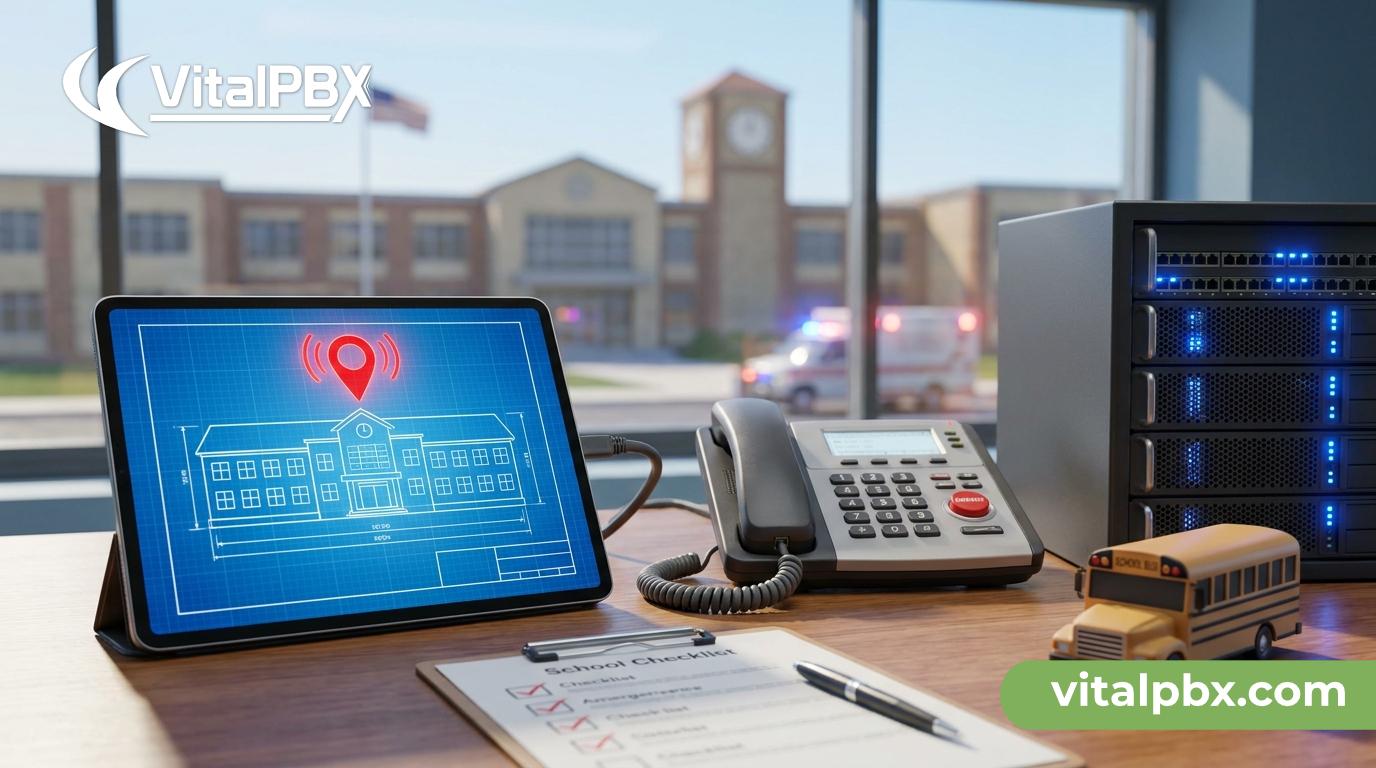
Kari’s Law and RAY BAUM’S Act Compliance for School Phone Systems: A District IT Guide
When a student or staff member dials 911 from a school phone, every second matters. But for years, a silent flaw in many school phone systems meant that call might never connect — or first responders might arrive at the wrong building entirely. That flaw is exactly what Kari’s Law and RAY BAUM’S Act were designed to fix.
If you’re an IT administrator managing a K–12 or higher education phone system, understanding these two federal mandates isn’t optional. Non-compliance carries real legal and financial risk, and more importantly, it puts people in danger. This guide breaks down what each law requires, what your phone system must do to comply, and how a modern on-premise PBX like VitalPBX helps you meet every requirement without overhauling your entire infrastructure.
We’ll cover the legal background, the specific technical requirements, common compliance gaps in older school phone systems, and what to look for in a compliant solution.
What Are Kari’s Law and RAY BAUM’S Act?
These two laws emerged from real tragedies — and understanding that context helps explain why compliance is non-negotiable.
Kari’s Law was signed into federal law in February 2018. It takes its name from Kari Hunt, who was murdered in a Texas hotel room in 2013. Her daughter tried to call 911 from the room phone multiple times but didn’t know she had to dial “9” first to reach an outside line. The calls never connected. Kari’s Law mandates that any multi-line telephone system (MLTS) in the United States must allow users to dial 911 directly — without a prefix, access code, or trunk-dial digit.
RAY BAUM’S Act (Repack Airwaves Yielding Better Access for Users of Modern Services Act) extended that protection further. Section 506 of the Act requires that when a 911 call is placed from an MLTS, the system must automatically transmit a “dispatchable location” — a specific, actionable physical address — to the 911 call center (PSAP). For large campuses with multiple buildings or floors, this is critical. A general street address is no longer enough.
Both mandates were phased in by the FCC. Fixed MLTS systems (like those in schools and office buildings) were required to comply with Kari’s Law requirements beginning February 16, 2020, and with RAY BAUM’S Act dispatchable location requirements beginning January 6, 2021.
If your school district is still running a legacy PBX or hosted VoIP system that hasn’t been updated, you may already be out of compliance.
Why School Phone Systems Are Especially Vulnerable
Schools present a uniquely complex compliance challenge. Most K–12 districts operate across multiple physical campuses, each with its own buildings, wings, floors, and classrooms. Universities are even more sprawling.
Here’s where older systems typically fail:
Legacy PBX trunk-access codes. Many school phone systems were configured decades ago with “9” or “8” as a required prefix to reach an outside line. Under Kari’s Law, that configuration is now illegal for 911 calls. Direct 911 dialing must work from every extension.
Vague or absent location data. An older system might send your district’s main address — say, “123 Main Street, Springfield” — on every 911 call, regardless of which building or room the call came from. Under RAY BAUM’S Act, the PSAP needs to know which specific building, floor, and ideally which room or wing is involved. Sending a campus-wide address wastes critical response time.
No notification to on-site staff. Kari’s Law also requires that the MLTS send a notification to a central location within the facility (like the front office or a security desk) whenever a 911 call is placed, so on-site staff can respond immediately and direct first responders.
Decentralized management. Districts with separate phone systems per campus often have inconsistent configurations. One school might be compliant while another isn’t — and a single non-compliant building creates district-wide legal exposure.
All of these issues are solvable. But they require a phone system that was either built with these requirements in mind or has been properly configured and tested.
The Four Technical Requirements Every School Must Meet
Let’s make this concrete. Here is what your phone system must do to satisfy both Kari’s Law and RAY BAUM’S Act:
1. Direct 911 Dialing — No Prefix Required
Every extension on your system must be able to dial “911” and connect directly to the local PSAP. No “9-911,” no access codes, no workarounds. This applies to every phone on every campus.
2. Automatic Notification to On-Site Personnel
The moment a 911 call is placed from any extension, the system must automatically notify a designated on-site location. This is typically a front office phone, a security desk, or a notification screen. The notification must include the extension number and location of the caller.
3. Dispatchable Location Transmission
The outbound 911 call must include a dispatchable location — not just a street address, but an actionable address that includes the building, floor, and (where possible) room or suite number. This data must be automatically attached to the call and delivered to the PSAP.
4. Consistent Application Across All Extensions
Compliance isn’t per-campus — it’s per-extension. Every phone on your MLTS, whether in the main office, a portable classroom, a gym annex, or a remote administration building, must meet all three requirements above.
How VitalPBX Helps Schools Achieve Full Compliance
VitalPBX is an enterprise-grade, open-source PBX platform built on Asterisk, and it gives district IT administrators the tools to meet all four compliance requirements from a single, centrally managed system.
Here’s how each requirement maps to VitalPBX capabilities:
Direct 911 Dialing
VitalPBX’s outbound routing is fully configurable. You can define emergency dialing rules that override any default dial patterns, ensuring that “911” routes directly to your SIP trunk or PSTN gateway without any prefix requirement. You can also create failover routes so that if one trunk is unavailable, the call is automatically rerouted — a critical redundancy for emergency scenarios.
Automatic 911 Notification
Using VitalPBX’s built-in alerting and dialplan flexibility, you can configure the system to automatically trigger a call or notification to a designated extension — your front desk, security station, or school resource officer — the instant any extension dials 911. This satisfies the Kari’s Law notification requirement and keeps your on-site team in the loop in real time.
Dispatchable Location via SIP Headers and E911 Provider Integration
VitalPBX supports integration with E911 service providers that handle dispatchable location delivery to PSAPs. You can assign per-extension location data — building name, floor, room number — and pass it through the appropriate SIP headers or via your E911 provider’s API. For multi-campus districts, this means each building’s phones carry that building’s specific location data. Your SIP trunking provider or E911 service (such as those compliant with the NENA i3 standard) handles delivery to the PSAP.
Centralized Multi-Campus Management
This is where VitalPBX’s architecture provides a significant operational advantage. Rather than managing a separate phone system for each school in your district, VitalPBX’s Multi-Tenant capability allows you to run multiple logical PBX instances — one per campus, if needed — all from a single server and a single administrative interface. Each tenant can have its own dial plans, outbound routes, and extension location data, while you maintain oversight from one place.
For larger districts, the Enterprise plan supports up to 5,000 extensions on a single deployment. And critically, VitalPBX charges no per-user or per-extension fees — so adding extensions across every campus doesn’t change your licensing cost.
Explore VitalPBX Plans and Features — https://vitalpbx.com
Compliance Gaps to Audit Before Your Next School Year
Before you assume your current system is compliant, run through this checklist:
- [ ] Test direct 911 dialing from at least five random extensions on each campus. Confirm no prefix is required and the call connects.
- [ ] Verify your E911 registration. Check with your SIP trunk provider or E911 service to confirm that per-extension or per-location dispatchable address data is registered and current.
- [ ] Test the 911 notification. Dial a test number (not 911 itself — coordinate with your local PSAP for testing procedures) and confirm that your front desk or security desk receives the automated notification with the correct extension and location.
- [ ] Audit remote and portable locations. Portable classrooms, trailers, and off-campus administrative offices are often missed. Every extension on the MLTS is covered by the law.
- [ ] Review your SIP trunk agreement. Confirm that your provider supports E911 with dispatchable location. Not all SIP providers do by default.
- [ ] Document your compliance configuration. If you’re ever audited by the FCC or face a legal inquiry after an incident, you need records showing your system was properly configured and tested.
VitalPBX Plans for School Districts
VitalPBX offers flexible licensing designed to fit educational institutions of any size:
Enterprise Plan — Supports up to 5,000 extensions with the full feature set, including advanced outbound routing, call recording, voicemail with AI transcription, and multi-campus management tools. Ideal for mid-size to large K–12 districts and universities.
Call Center Plan — Includes all Enterprise features plus the Sonata Stats reporting suite and outbound dialing management. Useful for districts that also operate centralized help desks or parent communication centers.
Multi-Tenant Plan — Designed for MSPs or IT teams managing multiple schools as separate logical PBX environments from a single server. Each campus tenant is independently managed but centrally hosted.
All commercial plans include priority support — meaning when something affects your 911 configuration, you’re not waiting in a community forum for an answer.
Start a Free Trial — https://vitalpbx.com/checkout/?add-to-cart=2271&requestsubscriptiontrial=true
Frequently Asked Questions
What is Kari’s Law and does it apply to schools?
Kari’s Law is a federal law enacted in 2018 that requires all multi-line telephone systems (MLTS) in the United States to allow direct 911 dialing without any prefix or access code. It also requires that a 911 call automatically notify a central on-site location within the building. Schools are explicitly covered under this law, as they operate MLTS environments. Compliance was required as of February 16, 2020.
What is RAY BAUM’S Act and how is it different from Kari’s Law?
RAY BAUM’S Act (Section 506) builds on Kari’s Law by requiring that MLTS systems also transmit a “dispatchable location” — a specific, actionable physical address including building, floor, and room — whenever a 911 call is placed. While Kari’s Law ensures the call connects and on-site staff are notified, RAY BAUM’S Act ensures first responders know exactly where to go. Fixed MLTS systems were required to comply beginning January 6, 2021.
What counts as a dispatchable location under RAY BAUM’S Act?
A dispatchable location is a civic address plus additional information that allows a first responder to find the caller without additional investigation. For a school, this typically means the street address of the specific building, plus the floor number and room or area identifier. A generic campus address or district headquarters address does not satisfy the requirement. Your E911 provider and SIP trunk configuration must be set up to pass this data to the PSAP automatically.
Can VitalPBX be configured to meet both Kari’s Law and RAY BAUM’S Act requirements?
Yes. VitalPBX supports direct 911 dialing through configurable outbound routing rules, automatic notification to designated on-site extensions when 911 is dialed, and integration with E911 service providers that handle dispatchable location delivery to PSAPs. You can assign specific location data — including building and room information — to individual extensions or groups of extensions, making campus-by-campus compliance manageable from a single administrative interface.
What happens if a school’s phone system is not compliant with Kari’s Law?
Non-compliance with Kari’s Law and RAY BAUM’S Act can result in FCC enforcement actions and financial penalties. More significantly, if an emergency occurs and the phone system fails to connect a 911 call or provide accurate location data, the district may face serious legal liability. Beyond the regulatory risk, non-compliance is a direct safety failure — one that can cost lives, as Kari Hunt’s story tragically demonstrated.
Does VitalPBX charge per extension or per user for school deployments?
No. VitalPBX’s commercial plans — including Enterprise, Call Center, and Multi-Tenant — do not charge per extension or per user. Whether your district has 50 extensions or 5,000, your licensing cost remains the same. This makes VitalPBX a cost-effective choice for school districts that need to ensure every phone on every campus is covered without budget surprises.
Do portable classrooms and off-campus locations need to be compliant too?
Yes. Kari’s Law and RAY BAUM’S Act apply to every extension on a multi-line telephone system, regardless of where that phone is physically located. Portable classrooms, modular buildings, off-campus administrative offices, and temporary facilities all fall under the same requirements as your main campus phones. Each of those extensions must support direct 911 dialing, trigger staff notifications, and transmit a dispatchable location.
Make Compliance a Certainty Before the Next Emergency
Kari’s Law and RAY BAUM’S Act exist because lives were lost due to preventable failures in phone systems. As a district IT administrator, you have both the technical responsibility and the legal obligation to ensure your school’s communication infrastructure meets every requirement.
The good news: the technical path to compliance is clear, and VitalPBX gives you the tools to get there — direct 911 routing, automatic notifications, E911 integration, and centralized multi-campus management — all without per-user fees and all from a platform built on proven, open-source Asterisk technology.
Whether you’re evaluating VitalPBX for the first time or looking to bring an existing deployment into full compliance, our team can walk you through exactly what your district needs.
Book a personalized demo with a VitalPBX specialist today.
(European time zones: book here)